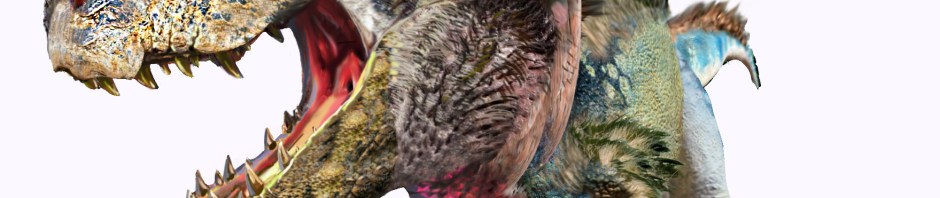

I think we have seen them all… from the ubiquitous bare teeth grin, to the sedated, solemn face of the T. rex from Prehistoric Planet.
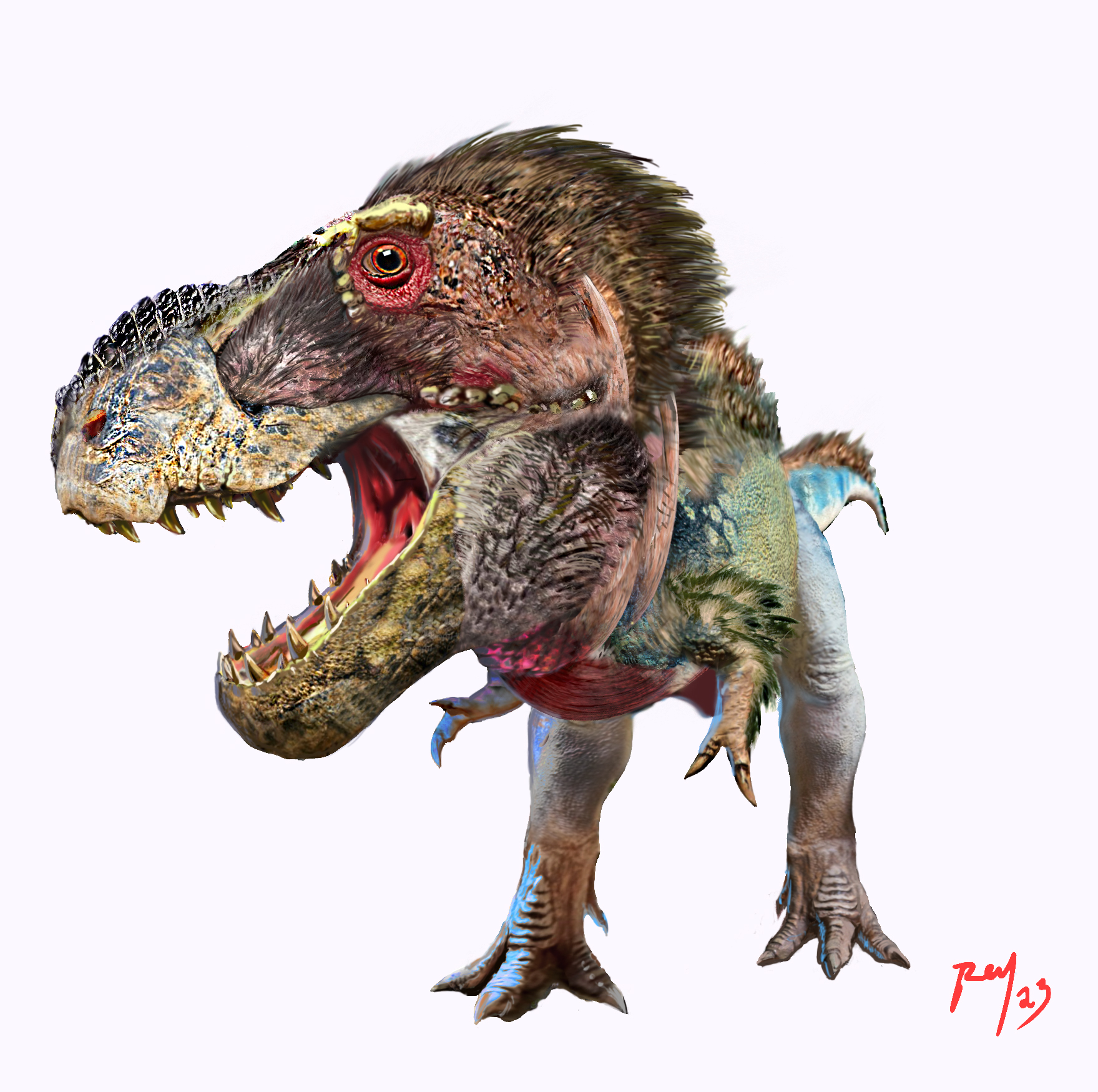
In my quest for a new look for Tyrannosaurus I would like to start 2023 with a portrait of Stan that would defy convention and make him more avian than ever. I have tried it before but not to this extent: instead of having an extensively scaly snout, it has now a full horny coverage that is more like a beak… and these are the results… might be successful or not, but I had to try once again.
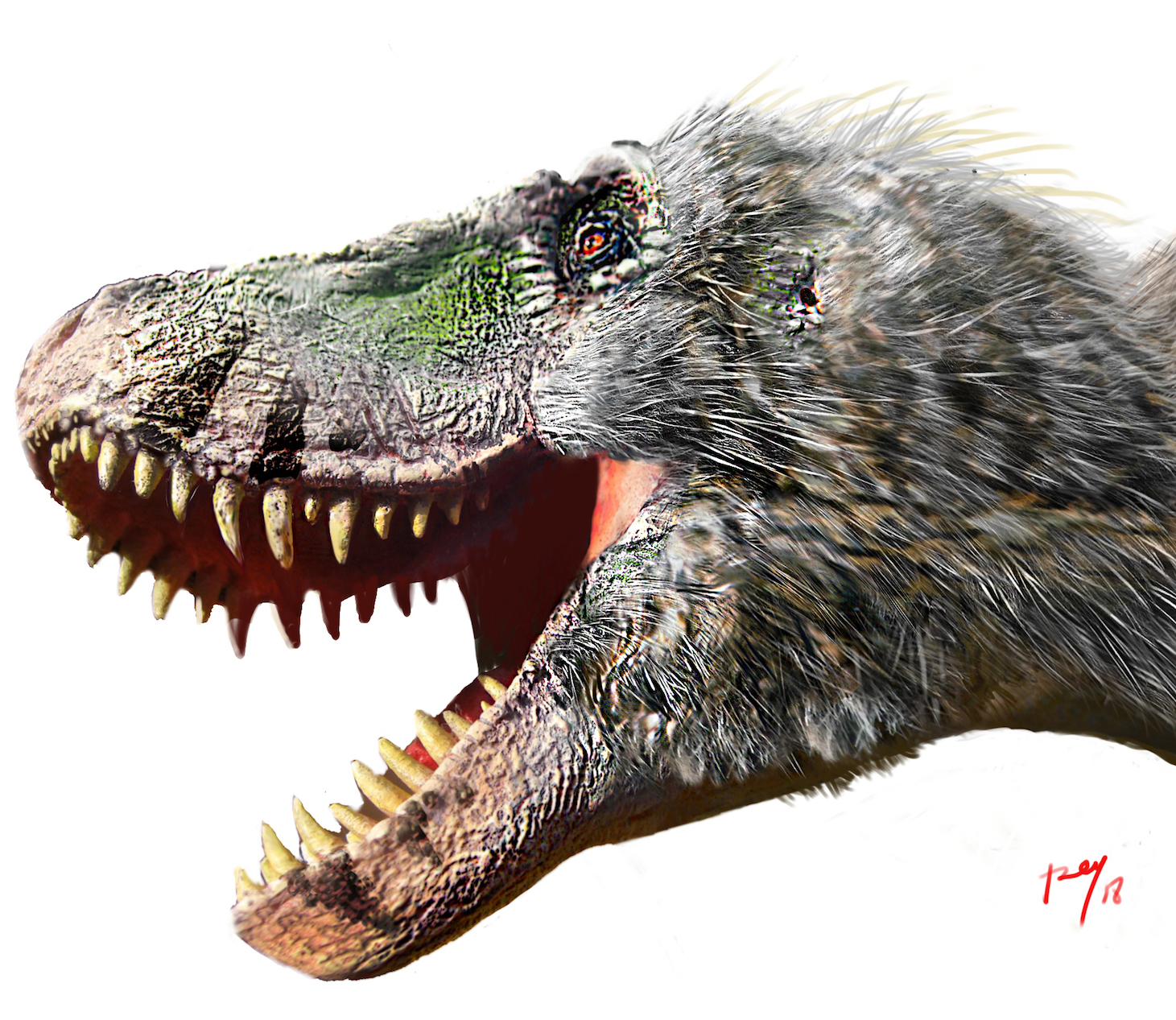
Yes, the toothy T rex is gone and for good reason. Every possible skull (including Stan) have the teeth virtually out of their sockets and, when you closely examine the teeth themselves, the enamel traces show very clearly what part was “out” or “in” the gums… as it happens most of the teeth were inside soft tissue and the roots were enormous. So much for the “banana” teeth grin… still the thickness and power of those teeth were bone crunching remarkable. Quite a few of them would show for sure, but not like the earlier reconstructions.


 Luis V. Rey Blog
Reblogged this on Palpatine's Literary Library and commented:
I find this kind of thing absolutely delightful to observe that he’s done.
This’s absolutely delightful to observe the natural history in this.
Great new look for Rexy, Luis, up to date and also with a lot of character to it!
Skin prints have been found of T-rex and its closest relatives, on which no fethers can be see. So this reconstruction is probably wrong.
https://www.deviantart.com/paleonerd01/art/Tyrannosauridae-skin-chart-grey-literature-883995243
Interesting to find out; yet it is likely the animal had feathers of a sort: because it was basically a gigantic bird via appeals to its anatomy.
OK. Besides the fact that those skin fragments are minuscule (the skin bumps measure in mm.) and they are not from any specified part of the animal…Have you seen fossilized skin of prehistoric penguins? They look virtually the same. I have also considered (with Dr. Bob Bakker) that those sakin fragments might be subcutaneous. The argument that the animals are too big to have feathers is proven not valid… because there are very big birds or even mammals that even in the tropics have some sort of insulating coverage, at least in certain parts of the body. If you add that virtually all the T. rex ancestors had feathery coverage… it might be parsimonius to conclude that they >might< have had some sort of feathery or protofeathery coverage at certain stages of growth, including adulthood. We need conclusive proof of one way or the other…
*And* to boot: just because someone does something on Deviantart does not in and of itself make it a valid scientific source- it *may* be, but it may also *Not* be a valid readout of the science.
Yet we *do* know the animal was basically a gigantic bird, very eagle-like in its behavior and anatomy in a lot of ways, including its metabolism… so it stands to reason that it did have some kind of covering, especially when it was young.
If it was young yes, but an adult T-rex was so big that it woud have gotten a heat stroke when it was fethered.
You are assuming primitive feathers would have the same function as present day feathers though. We all know that chicks are born with fluffy down to keep them warm and as they age they grow new kinds of feathers. What if adult feathers on dinosaurs helped disperse heat? (Shaft could help pull heat away from the body, perhaps).
The animals would actually have their temperatures aided in being more balanced by the covering it turns out: that’s one principle of insullation that actually has gotten men who work with intense heat to wear heavier covering: it helps to keep the heat away from the core temperatures.
Nope, as the additional covering would help to aid the animal in balancing its core temperature; it is the same effect as blacksmiths and/or firefighters wearing heavy coverings: they help to keep the extreme temperatues away from impacting their internal core temperatures.
We also know that most animals use evaporation to help cool down, whether it’s through gular fluttering, panting, excreting on themselves, or covering their skin with mud/water/saliva, and the more surface area, the better (think elephant ears, or how intestines/lungs have extensive folds/alveoli to maximize absorption). So if there are protofeathers of some sort (maybe all over, maybe just in certain places), that would increase surface area for heat dispersal – especially when wet. And a very large animal in a hot environment would definitely need an effective way to cool off.
Just some food for thought.
Yeah, and for instance; why do men like firefighters wear heavy coats if additional layers do not aid in temperature regulation; not so much about simply keeping warm?
Yet they clearly do function as that primarily.