
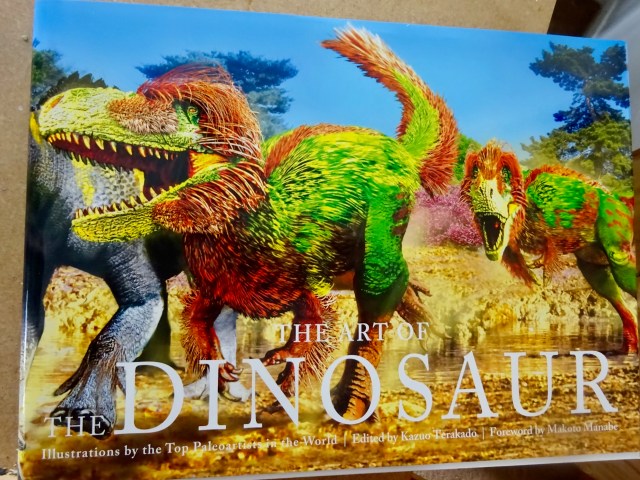
Presenting: The Art of the Dinosaur.
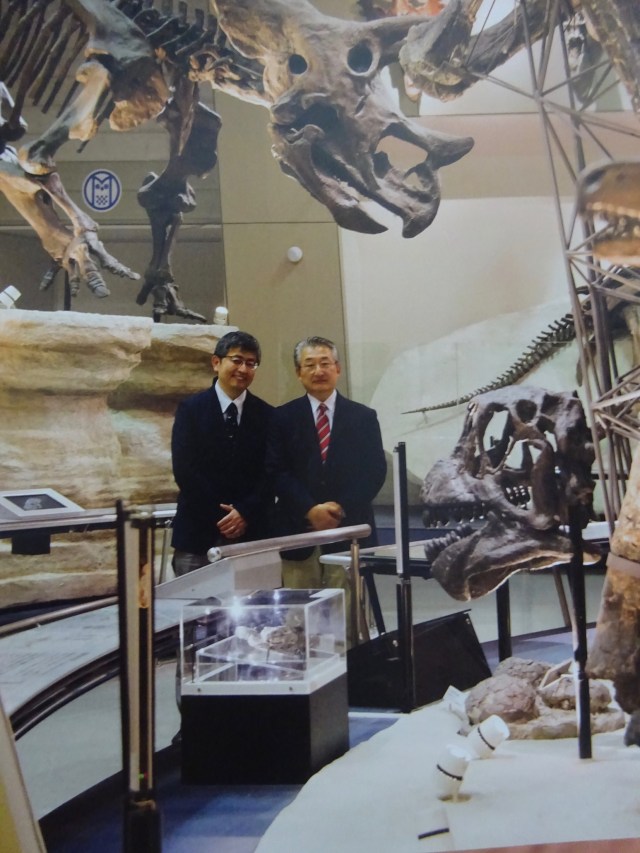
 It is difficult to describe my excellent relationship with a consummate professional like Mr. Kazuo Terakado, science journalist and senior researcher at the Japan Space Forum.
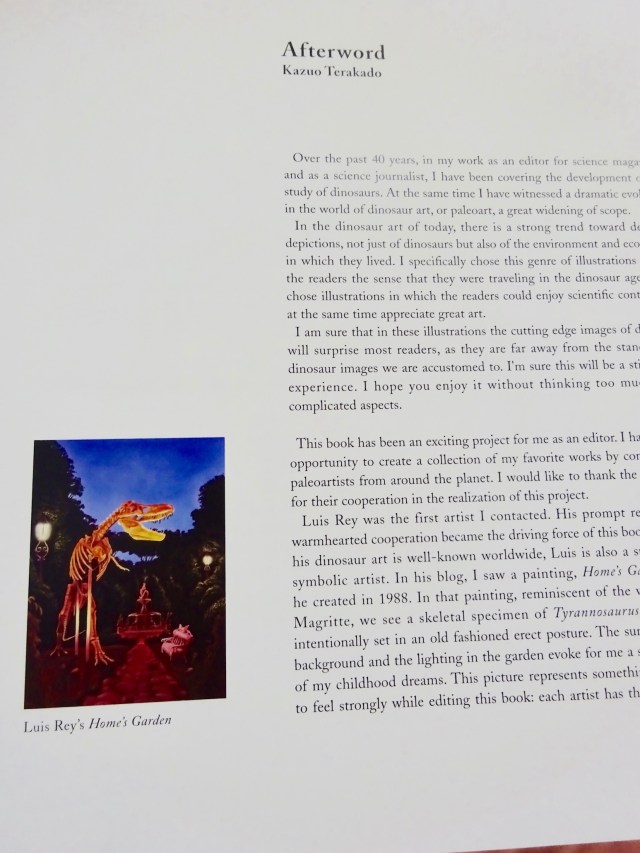
 His love for Dinosaur Art seems to have no bounds and has the right ideas for it. When he asked me if he could use my “Home’s Garden” for the last words of this excellent book, I understood that he knew very well what he was up to and knew the boundaries between science and “Art”. I’m very keen on the word “Paleoillustration” but as many know, I like to think that I’m interpreting scientific ideas through art techniques and leaving “art” in another realm. Perhaps it is true, we all develop a certain style that becomes almost a blueprint with our own personality… but illustrating Palaeontology has certain boundaries that “Art” doesn’t have… and those boundaries are called “science”: you have to be very careful to do your homework properly, well beyond mastering Photoshop techniques! Dinosaurs are NOT “monsters” anymore!


Nevertheless, as you’ll be able to still see, there’s an (almost) boundless realm of imagination for artists interested in recreating scientifically an extinct world. The competition these days is much more fierce than it was 20 or even 30 years ago, but every artist continues to develop his own personality, his own blueprint… and variety is what counts when doing Paleoillustration… For me the detective work was what counted, and the fact that many many years ago, a child dreamed to live in a museum… and happened to realise his dreams after all, but with the slant of the adult researcher and the new wonder that those fabulous monuments he was in awe of at the museums, were actually living creatures again, thanks mostly to the Dinosaur Renaissance… Today the Dinosaur Renaissance has exploded as you are able to see in the enormous variety of artists, apart from yours truly, that this book contains. It is a good example that variety of talent means everything for creativity… and it becomes even more relevant if it is compiled with the love and care that virtually only the Japanese publishers do these days! Many thanks Mr. Terakado!


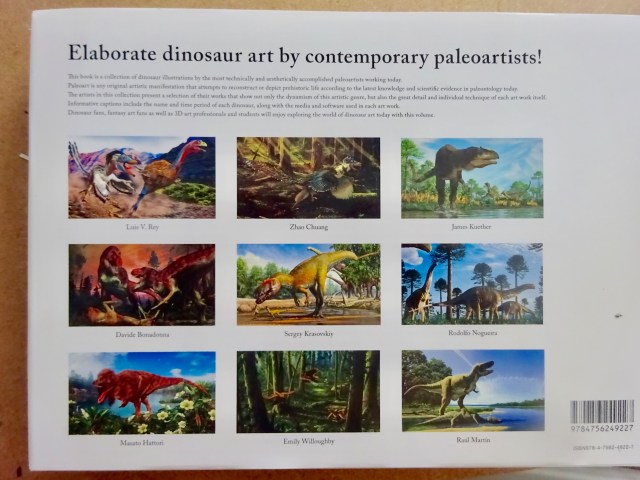 The book is available here and now , don’t miss it!
 It’s been a while since I do something spiky and scaly… no feathers this time! But I couldn’t resist the temptation: It is not very often there’s a find as this remarkable nodosaur fossil now at the Tyrrell Museum, the supreme Dinosaur Mecca in Alberta, Canada and made public by


 There’s hardly anything more thrilling for me than customising a fossil cast. It combines hard observation, painting and modelling skills and using the right materials. Above all, it is ideal to have a good reference you can use to copy to the last detail, but as you’ll be able to see, if you don’t have a proper Larry Witmer-style lab, this is not always possible. It is great to be able to alternate from my computer painting to three dimensional work, and is very educational. The results, although not perfect, have been better than I expected, even if I feel I’m just an amateur in the matter. Thanks to the good advice of Peter Norton of Gondwana Studios, having been frustrated for a long time with the use of acrylic paints on resin casts, I found that combination of enamels, airbrush and brushes can achieve the effects I was searching for. And there’s a lot more to investigate at the level of materials.


 So after working with René Hernández, Angel Ramírez has set up and tried to reconstruct the animal based on its Nasutoceratops affinities… although it is not known, it probably had no nose horn and, just as in Yehuecauhceratops, the frill shows parietals that are wider than the squamosal.
 According the fossils around it, it was hunted by small tyrannosaurs with Daspletosaurus or Albertosaurus characteristics and there were big tree trunks, since the region wasn’t as coastal as the others I have been depicting. Yet another window into the fragmentary, but abundant, fossil material from Mexico.
 Please click in the links…


 The danger of having extremely fragmentary dinosaur remains like the ones found in Mexico is that they are bound to different interpretations… and if we are not careful we can end up in opposite directions when it is time to reconstruct the animals. Meet my own take to a male and a female Yehuecauhceratops mudei, the now famous mid-sized ceratopsian from the Late Cretaceous Coahuila, Mexico.


