
About twenty years ago I was collaborating with the famous Kaiyodo label from Japan, trying to promote their wonderful models here in London. They were so advanced for their time that I really wanted to have them all and customise them according to my own colourful patterns… something that they appreciated so much that meant I started to receive all sort of samples… this was one of my favourites. A Velociraptor over a vanquished Protoceratops.
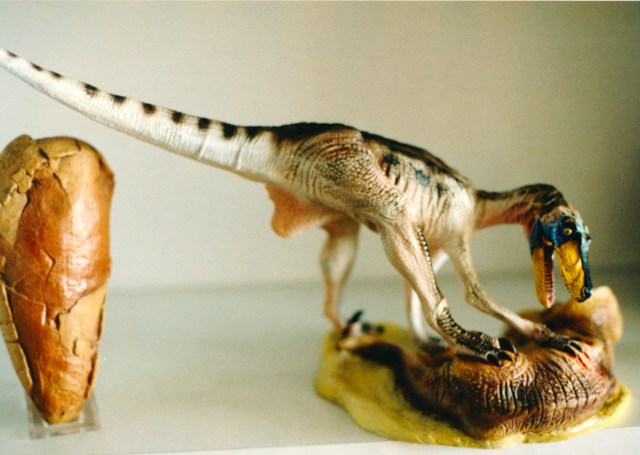
Unfortunately Palaeontology has been changing at a vertiginous pace in these last twenty years… I had never dared to touch this model in particular, because among other things it would have meant to remodel the arms and specially: add the corresponding feathers! I must admit I’m not the greatest model customiser… but when I appreciate something I can only pay tribute to it doing my best to enhance and modernise it accordingly. The Kaiyodo models have proved durable and sometimes timeless… what to do?
Using Milliput is a rather lousy clay substitute… but it was all that I had at hand. I discovered that feathers could dissimulate some of the inadequacies of the old-fashioned construction of the arms and hands and actually remodelled it. Sometimes feather by feather… same happened with the tail!


After the modelling came the paint… and I just followed my original pattern, the same I have use all these years for Velociraptor. I like to keep things personal…


So here it is … finally revamped, update and its in its rightful place… With modelling and customising, fun never stops… Pure enjoyment!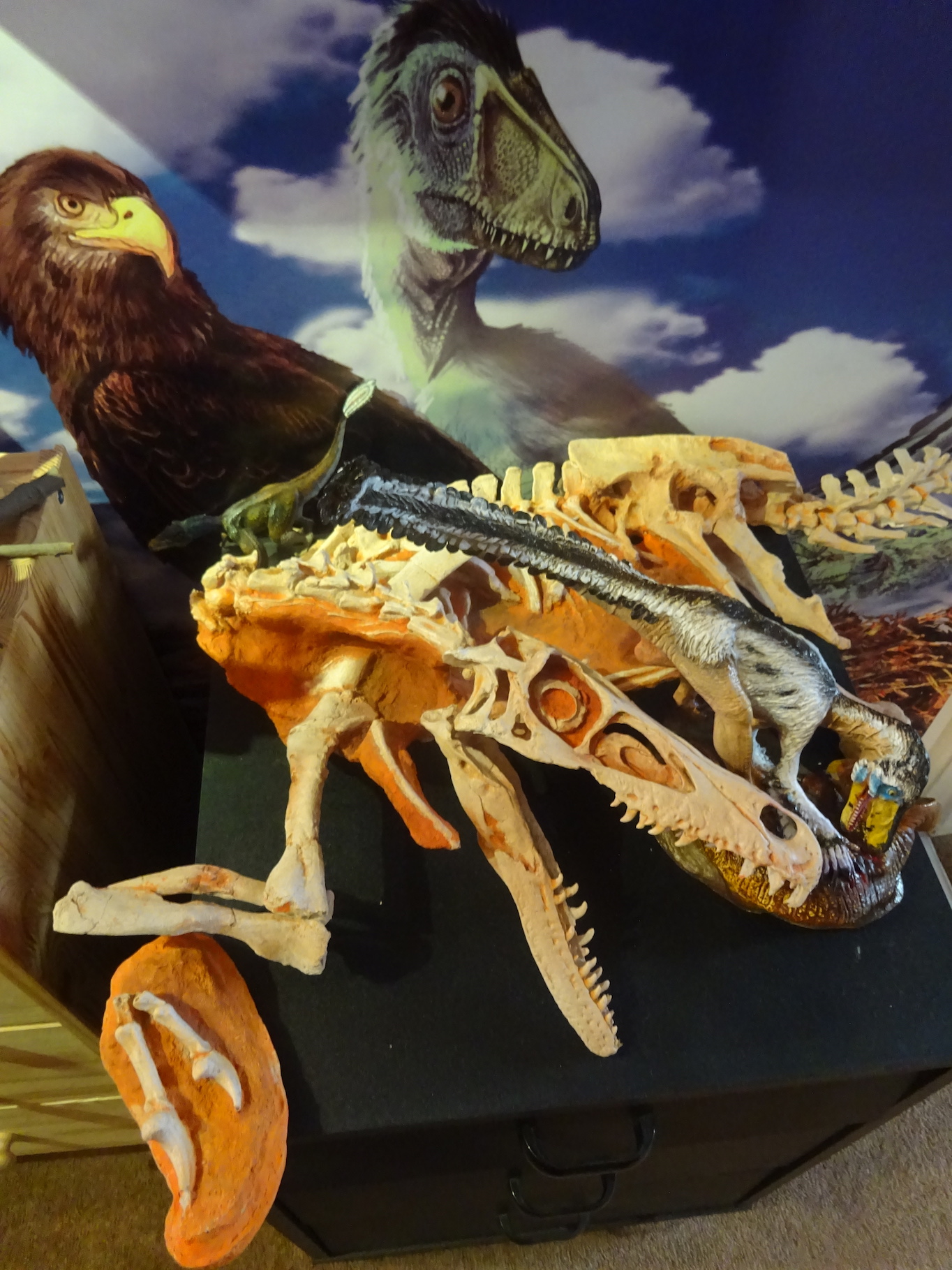
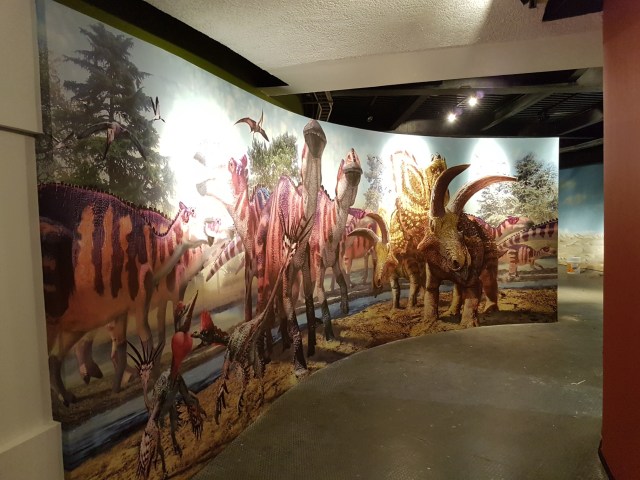


 For those who have seen them this might not be come as a surprise, but the spectacular way Planetario Alfa in Monterrey and Gondwana Studios are mounting the Mexican Dinosaurs murals, is really a surprise even to me!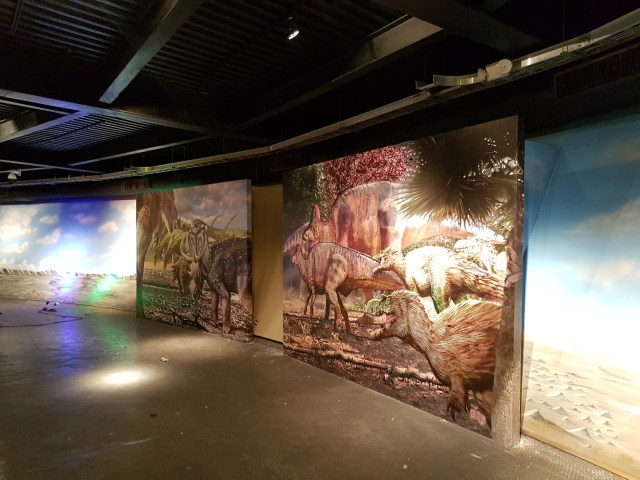


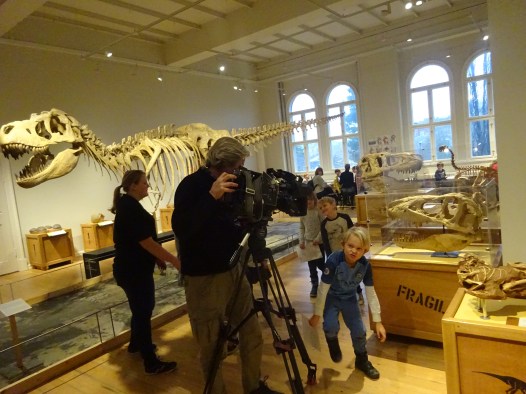
 When the Magovern’s (Charlie and Flo from StoneCo.) started this exhibition many years ago in Colorado, I bet they didn’t dream things would go this far! Our friends in Copenhagen also have been specially kind to me and this is the first time I even get to be photo-credited (scary as that might look!)…



 While we know a lot about Sinosauropteryx, to ‘almost’ even the level of colouration, we don’t know enough about Yi qi, the famous bat-like feathered dinosaur… its remains are not well enough preserved to be certain of many details like the extent and size of the wing membrane and its flying abilities… was it like a flying squirrel or a bat? For me it remains the proven, real first flying dinosaur but… Could it flap its wings? Scott Hartman tells me he doesn’t think it could fly battering its wings (the humerus proportions and the short deltopectoral crests wreck the leverage of muscles that would power the up and down stroke)… Scott is not even sure that it had bat wings! If it had them he says it instead used its wings to clamber trees in short jumps propelled by the wings… but he can’t be sure because the specimen is incomplete. Same happens with the shape and length of the legs. But one thing is almost for sure, this was not constructed as a flying squirrel because, dinosaurs are constructed differently: they were NO sprawlers, instead they had a combination of erect legs for running while using its arms for something else… like flapping perhaps?
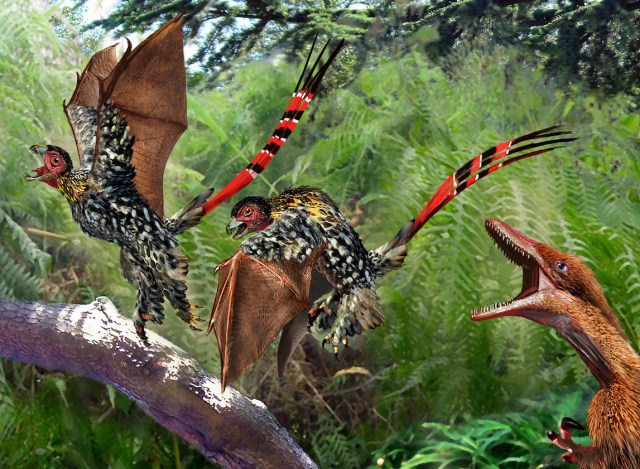 So what you see here is a compromise…And, while we are still trying to find morphological solutions and more evidence, these two animals are for me yet another excuse to exercise my fascination for feathery colour possibilities. Even if I acknowledge the evidence regarding the “ginger” colouration of Sinosauropteryx (and have changed my previous green versions accordingly), I think there’s much more in dinosaur feathers than reducing them to the current “black, white or ginger” orthodox patterns… nature is never as clear cut, and as this article provided to me by Thom Holtz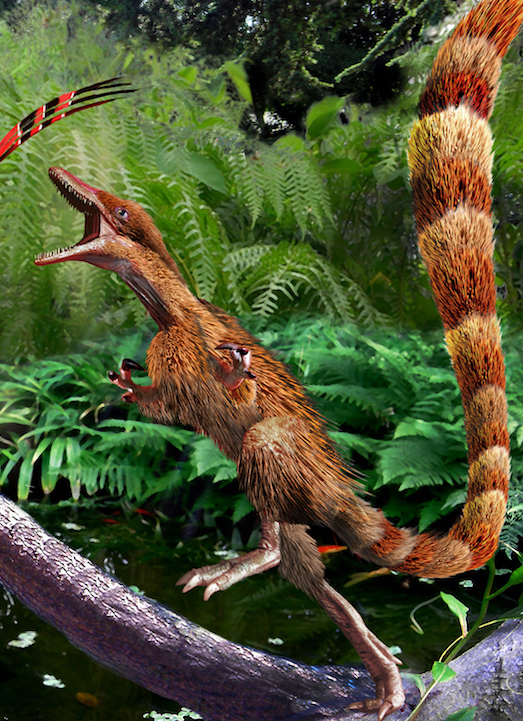

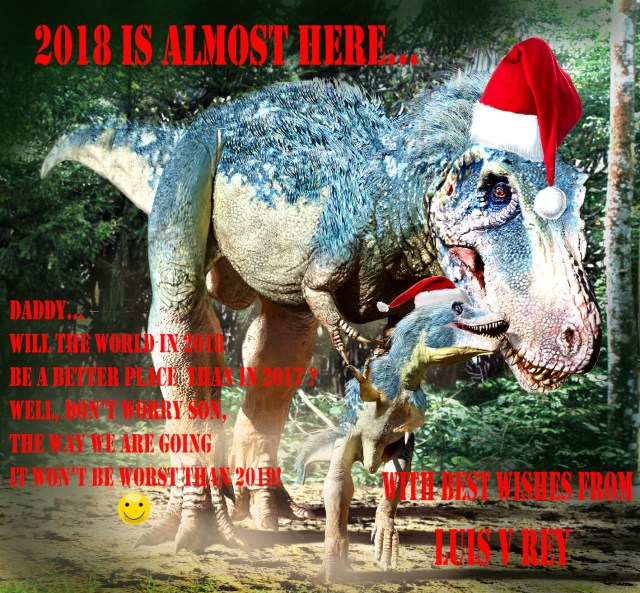 … and for those who don’t want celebration hats or anything to do with “holiday seasons”, here’s, by request, the original version of the illustration for the “postcard”… T. rex might have been a good parent in difficult times too!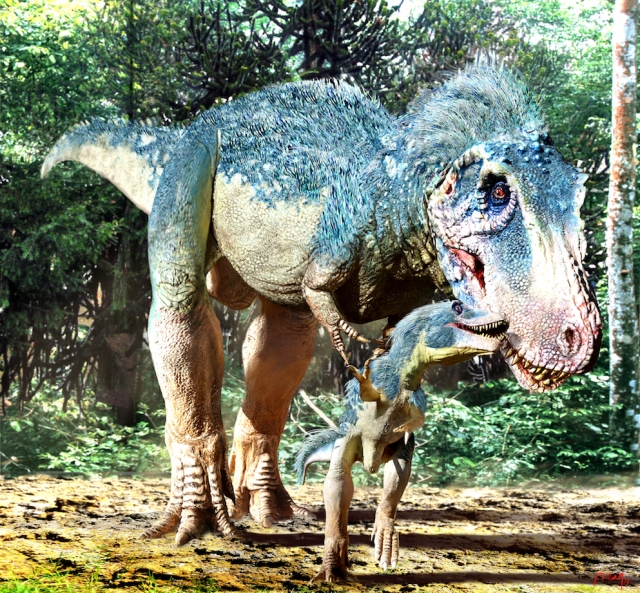
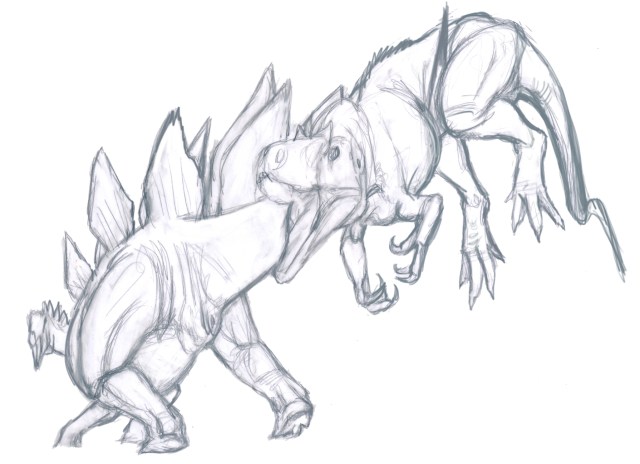
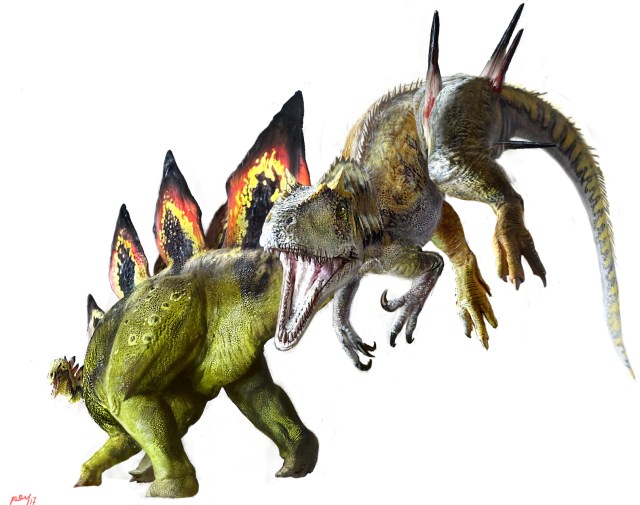
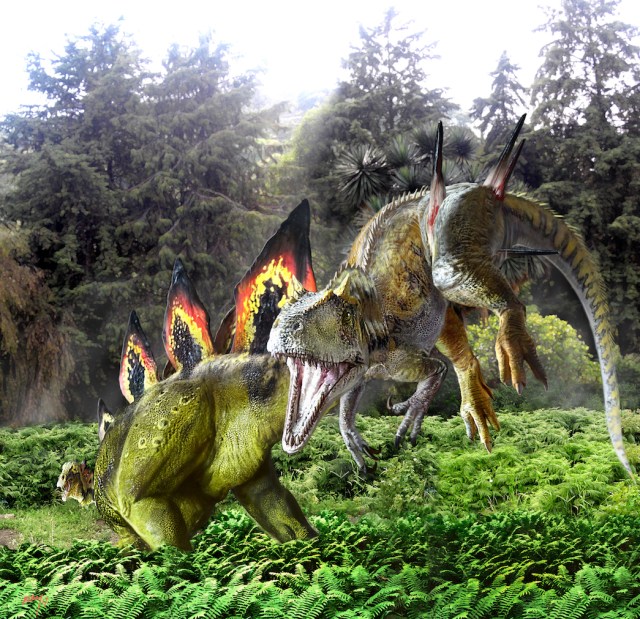 Imagine yourself walking quietly searching for prey on a field of ferns in the middle of a Jurassic tropical forest. You have good colour vision to spot any unusual coloration in the sea of greens. You discover some structures raising above the greenery and approach carefully… but you should have realised (just by the colour) that the row of structures were also warning signs… and the greenery is hiding the spiked end of it. Suddenly you are up in the air with the Stegosaurus stenops spikes lethally puncturing your crotch from underneath!

 And this time for real… No helping Diplodocus restorations, no talks, no scientific accuracy… only surrealism. Hope you can excuse indulging once again in my taste for Pre-hispanic Art and the fact that I keep turning to use its influence for some of my own paleo-interests . Yes the famous Aztec symbol of the eagle and serpent over a cactus (in remembrance of the legendary origin of Tenochtitlan, the Mexica capital, famously used as the Mexican flag’s national emblem) has been of special interest for me over the years. On my annual visit to Metepec near Toluca (Edo. de Mexico), inspired and aided by the workshop of Israel Soteno and Blanca Jiménez, and with their priceless help, I decided to do some more clay work inspired by a Prehispanic design I’ve seen years ago… and once again the raptor would go back in time and become a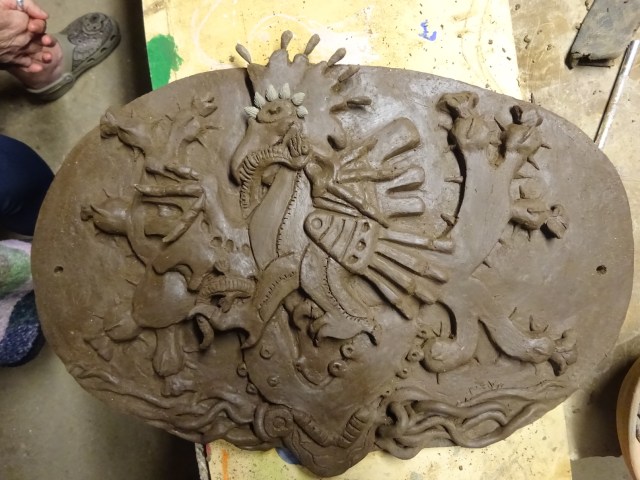
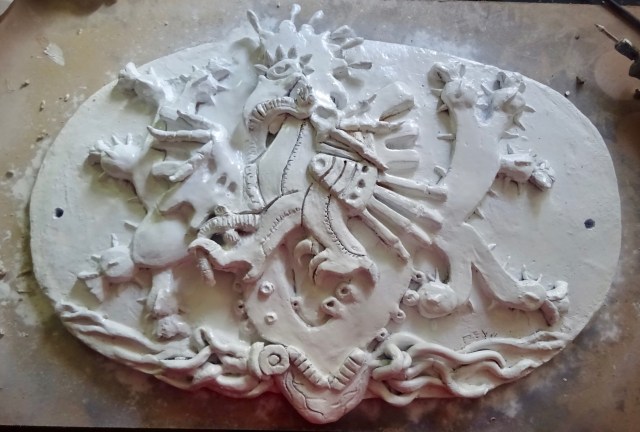 No. 2 shows it already painstakingly reconstructed and with an enamel coating to start painting it.


 Once Palaeontologists get their heads down to revise classification things start to be seen with different eyes and everything changes. There’s almost a full acceptance now on the newest reclassification of dinosaurs, that managed to challenge the traditional dinosaur evolutionary tree… we were used to see Dinosaurs as “Ornithischians” and “Saurischians”. No more: we have now Saurischia (subdivided in Herrerasauridae and Sauropodomorpha) and Ornithoscelida (subdivided in Theropoda and Ornithischia) ,

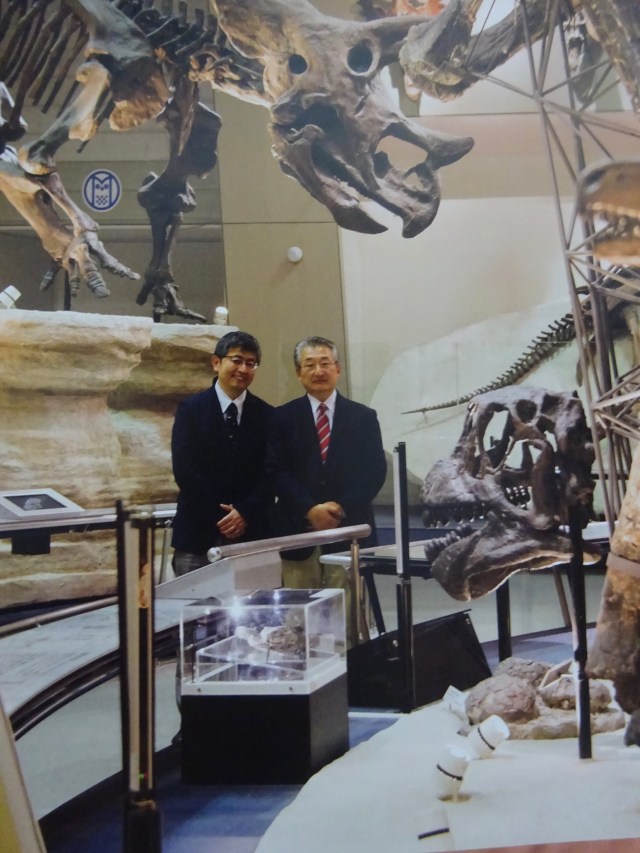
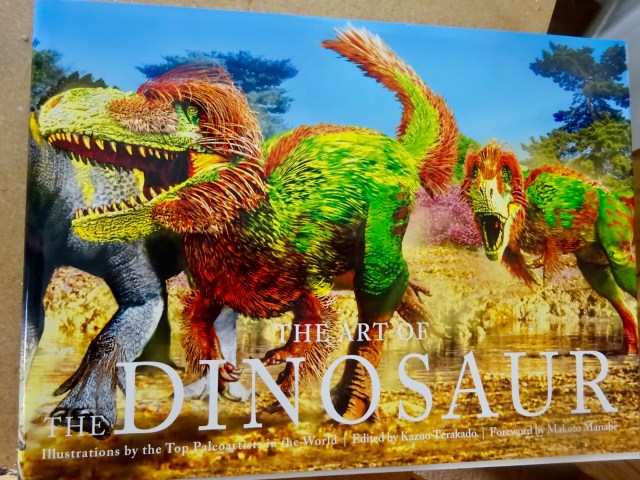 It is difficult to describe my excellent relationship with a consummate professional like Mr. Kazuo Terakado, science journalist and senior researcher at the Japan Space Forum.
  His love for Dinosaur Art seems to have no bounds and has the right ideas for it. When he asked me if he could use my “Home’s Garden” for the last words of this excellent book, I understood that he knew very well what he was up to and knew the boundaries between science and “Art”. I’m very keen on the word “Paleoillustration” but as many know, I like to think that I’m interpreting scientific ideas through art techniques and leaving “art” in another realm. Perhaps it is true, we all develop a certain style that becomes almost a blueprint with our own personality… but illustrating Palaeontology has certain boundaries that “Art” doesn’t have… and those boundaries are called “science”: you have to be very careful to do your homework properly, well beyond mastering Photoshop techniques! Dinosaurs are NOT “monsters” anymore!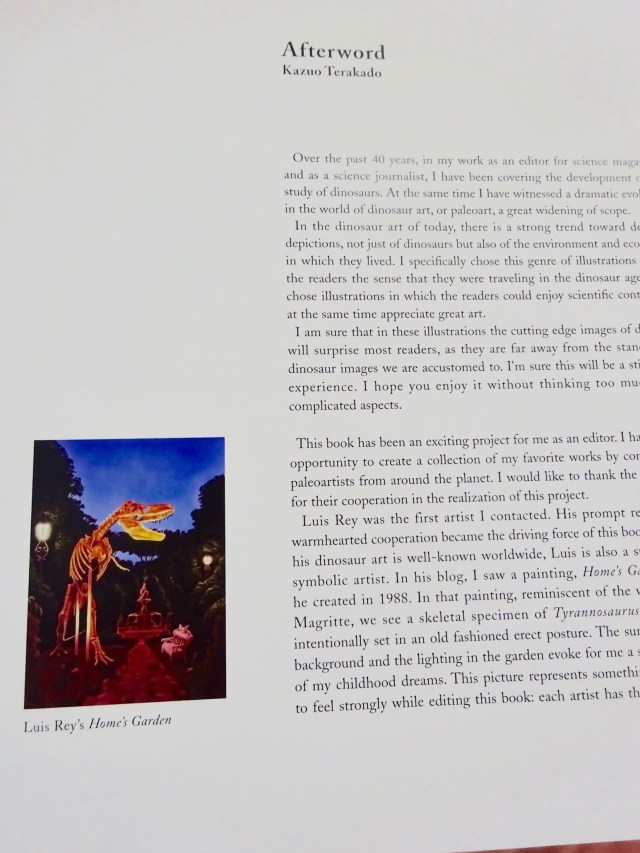


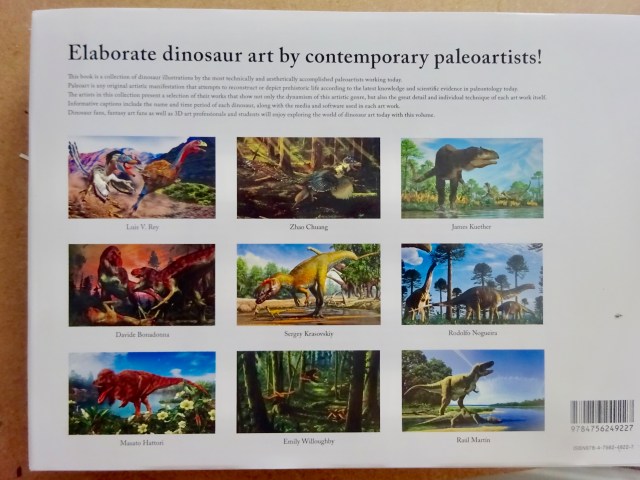 The book is available here and now , don’t miss it!
 Luis V. Rey Blog